

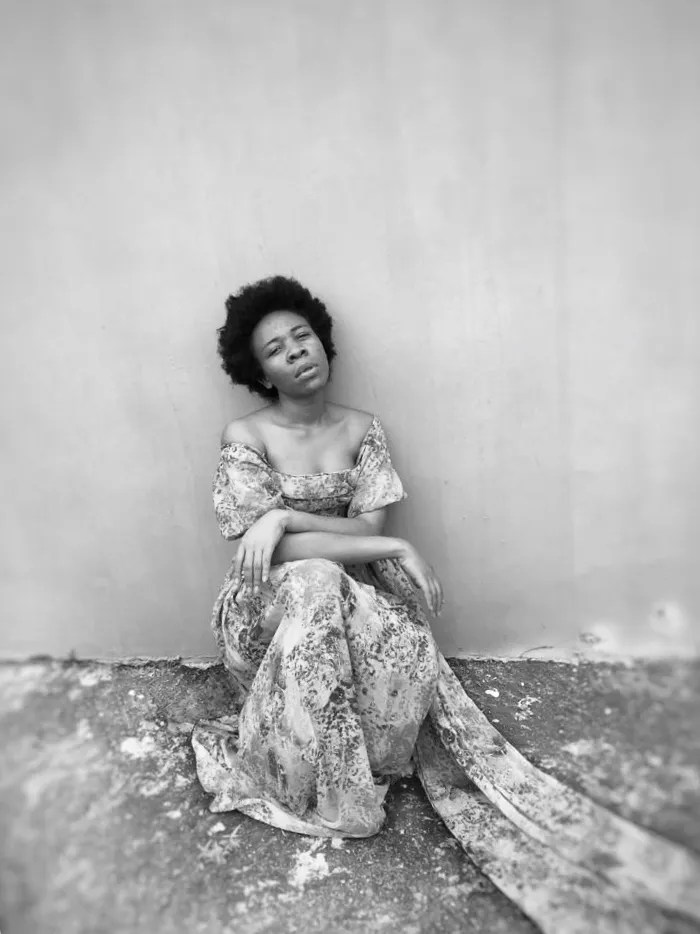
Earlier this year, I received a mail and found Obiageli A. Iloakasia’s second poetry collection Kàmbílí in it. She’d sent it to me in response to an essay I wrote—Where Are the 287 Poets Contesting the 2022 NLNG Prize for Literature?—published in Olongo Africa. Months later, I decided to do an interview with her. Our correspondence was via email and WhatsApp, across Makurdi, Enugu, Lagos, and Memphis (U.S.). Read our conversation below.

CARL TERVER
As writers, especially poets, we have a way of seeing the world differently because we’re very contemplative people. This sometimes pushes us into a kind of conclave where we want to be in solitude and observe the world differently, and have divergent opinions others find strange and too introspective. How do you cope with this with the people around you—with being a writer in Nigeria, especially in relation to your family and people close to you?
OBIAGELI ILOAKASIA
This is a very complicated thing. I don’t even know how I’ve been doing this. Some readers write me online to ask what I was thinking when I wrote a particular thing but I really can’t figure them out sometimes. As much as I struggle to be the sane person I genuinely am, these things take you unaware. Especially for poets. Sometimes, that inner person in you keeps pushing you to let it out. I don’t know how. But it is what it is. Also, the idea of Kàmbílí is letting me see life and express it on my own terms. Kàmbílí means let me live.
CARL TERVER
In the first part of the collection, survival i, there are many references to your mother. She appears as a haloed figure pervading your consciousness, especially when it comes to your relationship with men; in such a sense of you weaning yourself from her but at the same time having her words in your head as a whisper of caution.
OBIAGELI ILOAKASIA
Balance is the only reason, I can say.
CARL TERVER
What kind of balance?
OBIAGELI ILOAKASIA
I am a product of society. As much as I think of myself as a creative, and sometimes, having this burning desire to express myself the way I want, I still think her words have pushed me far and I’m not letting out any part of my experience for another. Let me add that my mum calls me to take down some poems when I post on WhatsApp. Especially poems exploring desire. She couldn’t understand why her daughter would confidently talk about such things. I remember her telling me to take down “We Made Magic,” which I think I first wrote at 21 or 22. Little did she know that years later, it will be a poem in Kàmbílí. I also think that our society is becoming more liberal, so she is getting more accommodating of certain things. Especially her friends randomly calling to tell her how they are proud of me and the work I’m doing. You know how that validation makes parents feel. [Laughs.] So she starts overlooking those things and sees them as almost normal.
CARL TERVER
Talking about balance, there are two lines in the poem titled “Lechery” which talks about your conflict dealing with lust, how you try to control your lust over a lover:
I have stared deeply
to understand your charm
and the secret of the love you preach
but like an arsonist in a room full of lighters,
I fail at being a good judge . . .
But I am more interested in the next two lines: “when will this veil of lust / tied around my head be set loose?” I feel there’s an ongoing dialogue between yourself and your mom here, which I feel is your personality embracing a sort of sexual freedom you don’t recognise at the moment. You think maybe it is society making you try to check your lust. But what if lust is not what you’re dealing with here but sexual freedom?
OBIAGELI ILOAKASIA
This conversation is the reason I see literature as a powerful tool that emancipates. It allows you to question things, and your thought process. More insight can be gleaned and newer worldviews discovered. I’m deeply appreciating the lens through which you are viewing “Lechery.” I didn’t have those when I wrote it. It was just an expression. But, you know, there’s a limit to what the poet can say of their work. [Laughs.] I cannot know everything. But I think we tend to see deeper into other writers’ work than ours.
CARL TERVER
In survival iii, the poems are about your life in a city. Mostly, I believe, about how you left home and decided to find your path, living alone and making your way through new terrain. But what I have observed also is how you have woven the city in this part of the book as a metaphor for the existential. What does this mean to you?
OBIAGELI ILOAKASIA
I first lived away from my parents, or my family, when I first moved to Enugu, from Makurdi. I was about to turn 21. And it was NYSC that led me there. So you know, a lot of nostalgic feeling. I was also trying to make sense of life generally. And found solace in writing about the city. I wrote a lot of postcards I hoped will form a part of my next book because I’ve always had the idea of Kàmbílí in mind. I just didn’t know when it would materialise.
CARL TERVER
What is going on in the poem “Preachers and Hoodlums”? It is one of the finest poems in Kàmbílí with the property of multiplicity. But for the sake of reading it through the lens of the city-as-existentialism, I would like to know what you were thinking when you wrote it. It reads like a dibia’s incantation. I can hear its rendition in Igbo, thundering in my ears and antagonising its victims.
OBIAGELI ILOAKASIA
After the news of Dr. Chinelo Nwando who died in the March 2022 Kaduna train attack made rounds on the Internet, I spent days reflecting on how this country constantly fails its citizens. How the terrorists, or bandits, are perpetually perpetrating evil and no measures are taken to ensure that they are stopped. Such thoughts haunt me. I take Nigerian problems to heart. It was while reflecting on that event that the poem emerged. I thought about pastorprenuers or religious leaders who do nothing but suck the last hope of the common Nigerian in the name of miracles, signs, and wonders. “Give all you have to God and you shall see his mighty hands in your life,” these preachers often say. As a Christian woman, I have never questioned giving as part of the Christian faith. Rather, what I’m trying to express is that many people who become preachers do so because it seems to be a lucrative venture in Nigeria.
Having conversed with friends who live abroad, especially in working societies, it has become obvious that living in a place like the US will instantly change the prayer requests of the typical Nigerian. Of which a typical prayer request includes a plea to God for power supply (not necessarily constant power supply), water, and good roads, among others. Through this poem, I attempted to interrogate the relationship between bandits (which I refer to as Hoodlums in it) and religious leaders (Preachers) who do nothing but take even the littlest things from us. I wanted the hoodlums to take up a part of the poem and the preachers, another part. I guess it was not entirely mine to navigate. I strongly think the poem had its reason for coming to me. It ended just the way it wanted its message to be communicated.
CARL TERVER
Since you divided Kàmbílí into parts, this poem doesn’t fit into this part that is mostly about the city. How can you reconcile this?
OBIAGELI ILOAKASIA
[Laughs.] I love it when people read my work and come up with suggestions like this. There’s a brief introduction to this section of Kàmbílí: uncertain as we are, we pray the journey’s wave does not consume us. As human beings, we are largely products of where we find ourselves. Placing this poem in the part that talks about “the city” is my attempt at capturing the different types of people and experiences that have met us here—this place. In other words, this country.
CARL TERVER
“they say in this city, / buried treasures must be found.” These lines are from one of the poems. And in the poem after it, we read, “noise continuously pollutes this city; / not giving us space to think / or the room to dream of a miracle,” as if in continuum. Why has the world designed itself to be like this—to make us think only of survival and never giving us the peace to find it, with all its noise? And what, for you, is this dream you have written about in this poem? What happens when you never have it?
OBIAGELI ILOAKASIA
Hope is the only thing that keeps a man alive. As humans, our first instinct for survival is that tomorrow will be a better day. And that is why we all keep trying. The dream is clearly to live, to survive. Consciously or unconsciously, everyone desires to live well. To work hard and live a good life. For parents, they expect to see their children grow and make a good life. It is a thing of pride. But the expectations of life approaches with uncertainties.
CARL TERVER
Is this why your imagination is preoccupied with “dawn” and “new day,” expressions repeated throughout Kàmbílí? What does this expression mean to you?
OBIAGELI ILOAKASIA
This question just made me think about something I discussed with a friend days ago. I told her that after reading October Blues, I realised that dawn, dusk, night, morning, and new day are words that run through many of the poems in the collection. I will not say that infusing these words is deliberate. However, most of my poems have hope hidden in them. For me, like many others, morning, new day, and dawn are words of hope or new beginnings. I would say that when I write, these words find their way into my work.
CARL TERVER
Your book begins with love. The first part is devoted to love poems. One notices the trail of longing after lost loves, passion and sensuality, and so on. I am interested, once again, in these two lines from “I Hate Love Poems”: “maybe I like what I hate / so I hate love poems.” Good work on the irony. This is preceded by the sentiment in these lines: “when love breaks you / and mends you / and still breaks you, / what is left to write about?” Now, do you think—because it is what I feel from reading the poem, as well as when I write about a similar subject—that there’s any sense in writing love poems as a means to experience closure? Or does this only give a sense of vain euphoria to the poet for simply writing another “fine” love poem?
OBIAGELI ILOAKASIA
Have you heard people say “love happens”? I have heard it so many times and used it a lot as well. There’s something very interesting about love: sometimes, it takes you unaware. Other times, you swear you will never go back to it but end up right in it. I guess that counts as the complexities of love. “I Hate Love Poems” is a poem where the persona has tasted sweet and ugly and, somehow, still wants a taste of it, over and over again. How can you like what you hate? It’s unexplainable! And thanks for the compliment. [Laughs.]
During the official presentation and launch of Kàmbílí in 2022, one of the panelists asked a question similar to yours. Her question was: why is there a repetition of fire in the first part of the book. The truth is: as a woman who grew up in a society where talking about your affection—or what we now think of as lust—towards a boy was seen as abominable, I wrote these to make readers or anyone who encounters Kàmbílí, understand that love, lust or passion, are feelings that human beings (especially Nigerians—expressing love as a Nigerian seems to be one of the most difficult things) can express. It should never be an abomination. Whether we, or our parents like it or not, both young and old people experience such feelings. It will be unreasonable to think that a fifteen or sixteen-year-old girl already into puberty does not have these feelings. If a mother thinks so of the girl, it means the woman is living in self-denial. This is not me trying to say that underage children should not be guided in matters of love. All I’m saying is that these feelings come and they are very natural.
CARL TERVER
I felt, while reading Kàmbílí, that some poems were fillers and judged this as a plan to have exactly 100 poems in the collection. At what point do you imagine a poet may have written enough, even with single poems, when they feel that urge to add an extra word, line, or stanza? And especially when they go ahead to do this? Reading poems, one finds, sometimes, that the work of a particular poem is done, the punch delivered, somewhere in the middle. But the poet keeps going on.
OBIAGELI ILOAKASIA
Not every poem written ever makes it into a collection. Sometimes, poems or punchlines are born out of basic, everyday conversations with friends. Especially if you have friends who can hold solid conversations. I’ve written several poems this way. Deciding to have 100 poems was not a forceful idea. I knew the poems I wanted to have in Kàmbílí and I collected the ones I felt would suit. I have others that never made it into the collection because to me it was not the time to let them out. And the truth is a poet never stops writing because they successfully published a book. It’s like a never-ending journey. There might be breaks or stops but it never truly ends. Expression is continuous. Some of the pieces in Kàmbílí are as old as seven years, if not more. But Kàmbílí was published in 2022. Sometimes, poems take time to ripen and when you have enough of it, it can as well fit into the volume you chose.
CARL TERVER
So you haven’t read poems you felt were unnecessarily long?
OBIAGELI ILOAKASIA
I think readers will be a better judge of this. [Laughs.]
CARL TERVER
So I guess we’re excommunicating you from the race of readers then?
OBIAGELI ILOAKASIA
[Laughs.] No poet gets it all right. That is why I said this should be the judgement of readers. I feel that about poems by other poets. But, you know, I cannot extensively judge my work.
CARL TERVER
I was actually talking about you reading poems by other poets, not the other way round. But I guess you missed that. However, what, in your opinion, is good poetry?
OBIAGELI ILOAKASIA
Oh. Thanks for the clarity. I read some poems and I feel that way. For me, good poetry should be tangible. When I say tangible, I mean it should have something you can hold on to. It can be from style, theme, language, or just anything that strikes. Good poetry should leave you with the exact emotion the poem attempts to project. It should leave you wondering who the poet is, and what kind of life the poet lives or must have lived.
CARL TERVER
What poems have given you this sensation you just explained?
OBIAGELI ILOAKASIA
Okot p’Bitek is a poet whose work I fondly talk about. I’m a strong lover of his poem “The Woman with whom I Share My Husband.” He wrote a lot of long poems but I read them and never want to stop. Àkpà Árinzèchukwu’s “After Suicide” is one contemporary poem I wholeheartedly love. You should read it. Talking about such poems will not be complete without me drawing your attention to “This is how we disappear” by Titilope Sonuga. To be honest, there are many more I read and never get enough of. Lastly, I must comment on Chinua Ezenwa-Ohaeto’s “I Try to Make Everything Right and Yet I Feel Everything Wrong.” It’s a poem from his chapbook, The Teenager Who Became My Mother:
“…I wish to let you know that in this my life,
there is no mystery more mysterious than my father
being taken from me when I was thirteen.
not even magic. not even afterlife.
at thirteen everything turned out a folded and shrinking aspen.
I left the boy I was for a man that I did not grow well enough to know.
when people see me and say that I look so much like my father―
though they are right―I begin to wonder if I’m actually living my life…”
The first time I encountered this poem, I felt it. I mean deeply. You should explore the chapbook if you haven’t. There’s a lot more I can talk about but talking about them will make this a never-ending conversation. [Laughs.]
CARL TERVER
Your writings show you are concerned about the state of things in the country. From October Blues, and in Kàmbílí, a poem “Scarlet,” is about the EndSARS Lekki tollgate shootings. What can be done to Nigeria? Which way is forward?
OBIAGELI ILOAKASIA
Nigeria needs saving. I do not know how we can be saved but we do need saving. If you have a way forward, I’d appreciate it if you intimate me a little about it.
CARL TERVER
Is Nigerian literature dead?
OBIAGELI ILOAKASIA
[Laughs.] This debate might never come to an end. Can we talk about this another time? Please, say yes!
CARL TERVER
[Laughs.] Well, as the old Catholic prayer says, As it was in the beginning, it’s a world that never ends. So does certain debates. There has been no time in our literary history where our literature was declared dead, until now. Don’t you think it is with good reason to worry about?
OBIAGELI ILOAKASIA
To be honest, writing means different things to different people. I maintain that the unending rants about the death of Nigerian poetry or literature are not entirely out of place. Critics are digging deep as to why the literatures produced by Nigerian writers are no longer Nigerian enough or sounds too foreign for home.
In a WhatsApp conversation with Bayo Aderoju, a Nigerian writer, I asked his opinion on Brittany Barker’s spokenword “On Ethics,” about how poetry has fallen to late capitalism. Barker questions why poets, or writers, have reduced poetry to nothing through the baseless poems they write to have the tag “poet” or get published. The video also reminded me of two links I suspect I shared with you in other conversations on what we can make of modern Nigerian poetry. Bayo said something that stuck in my head:
“Writing means different things to different people, of course it’s a subjective enterprise, and none of those meanings is less valid. Gatekeeping is funny. It is easier to talk than to do the job, write. I might be wrong, but I have come to see that those who talk more hardly know what they talk about, hardly write great themselves. Some of my favourite authors hardly talk. Writing is so hard to master that if you commit yourself totally to your craft you have little or no time left to talk.”
I loved his point of view and I think it is valid. As well, I loved your opinion in “O, Griefa” and saw sense in Michael Chiedoziem Chukwudera’s “The Miseducation of Nigerian Poets.” If we all think that Nigerian poetry or literature is dead, maybe we wouldn’t talk about it. The fact that we have interesting debates on it means that it is very much alive and we can feel it. To throw a little light on the above debates, I think poets must respect structures. In every form of art, there are canons and these should be taken seriously to ensure the preservation of our art.
CARL TERVER
Have you ever considered writing essays or fiction?
OBIAGELI ILOAKASIA
Yes. I have attempted fiction (short stories) on so many occasions. I have some interesting pieces I hope to submit to literary magazines. Same as essays. I have written quite a number. Creative nonfiction is a genre I’m exploring alongside poetry.
CARL TERVER
To end our conversation, I would like to ask you a question about endings. A story should have a good beginning, as well as a good ending. What book of fiction in your reading experience would you say has a great ending, so good its memory is stuck with you? And what makes its ending so profound to you?
OBIAGELI ILOAKASIA
This is a very thoughtful question. I must appreciate you for the perspectives you raise in literary conversations. Stay With Me by Ayobami Adebayo is a Nigerian novel I proudly talk about. I love its beginning, as well as its ending. Ayobami is a very gifted storyteller and she writes fiction with ease. Stay With Me gave me the closure I wanted from the book. I’m so glad Ayobami never killed the urge to write that book. If you haven’t read it, I am recommending it.♦

Obiageli A. Iloakasia is a Nigerian writer, the author of two books of poetry October Blues (2021), and Kàmbílí (2022). She was a finalist for the 2022 SprinNG Women Authors Prize, for her book Kàmbílí. Obiageli is currently studying for an MFA in Creative Writing at the University of Memphis, Tennessee. Find more about her via www.obiageli-iloakasia.com